
Average cost
£1800–£2500
Typical range
£1500–£3000
Species
Dog & Cat
Category
Diagnostics
Anaesthesia
Required
How much does mri scan cost?
MRI Scan typically costs £1800–£2500 in the UK, though prices can range from £1500 to £3000 depending on your location, the practice, and your pet's individual circumstances.
Costs are UK averages based on publicly available data. Actual prices vary by practice, location, and animal size.
What affects the price?
| Factor | Impact on cost | Example |
|---|---|---|
| Body area scanned | Scanning multiple regions or adding contrast dye increases the cost | A single brain scan (£1,500–£2,000) vs brain and spine with contrast (£2,500–£3,000) |
| Referral centre | MRI is only available at specialist or referral hospitals, and prices vary between centres | £1,500–£2,200 at a regional referral centre vs £2,000–£3,000 in London |
| Pet size | Larger animals require more anaesthesia and longer scan times | A cat or small dog (£1,500–£2,000) vs a large breed dog (£2,200–£3,000) |
| Additional procedures | If a cerebrospinal fluid (CSF) tap or biopsy is performed at the same time, costs increase | MRI alone (£2,000) vs MRI plus CSF analysis (£2,500–£3,000) |
What's included in the price?
- Pre-anaesthetic blood tests and health check
- General anaesthesia and full monitoring
- MRI scan of the specified region
- Interpretation by a veterinary specialist (often a neurologist or radiologist)
- Written report with images
- Post-anaesthetic recovery and monitoring
What to expect
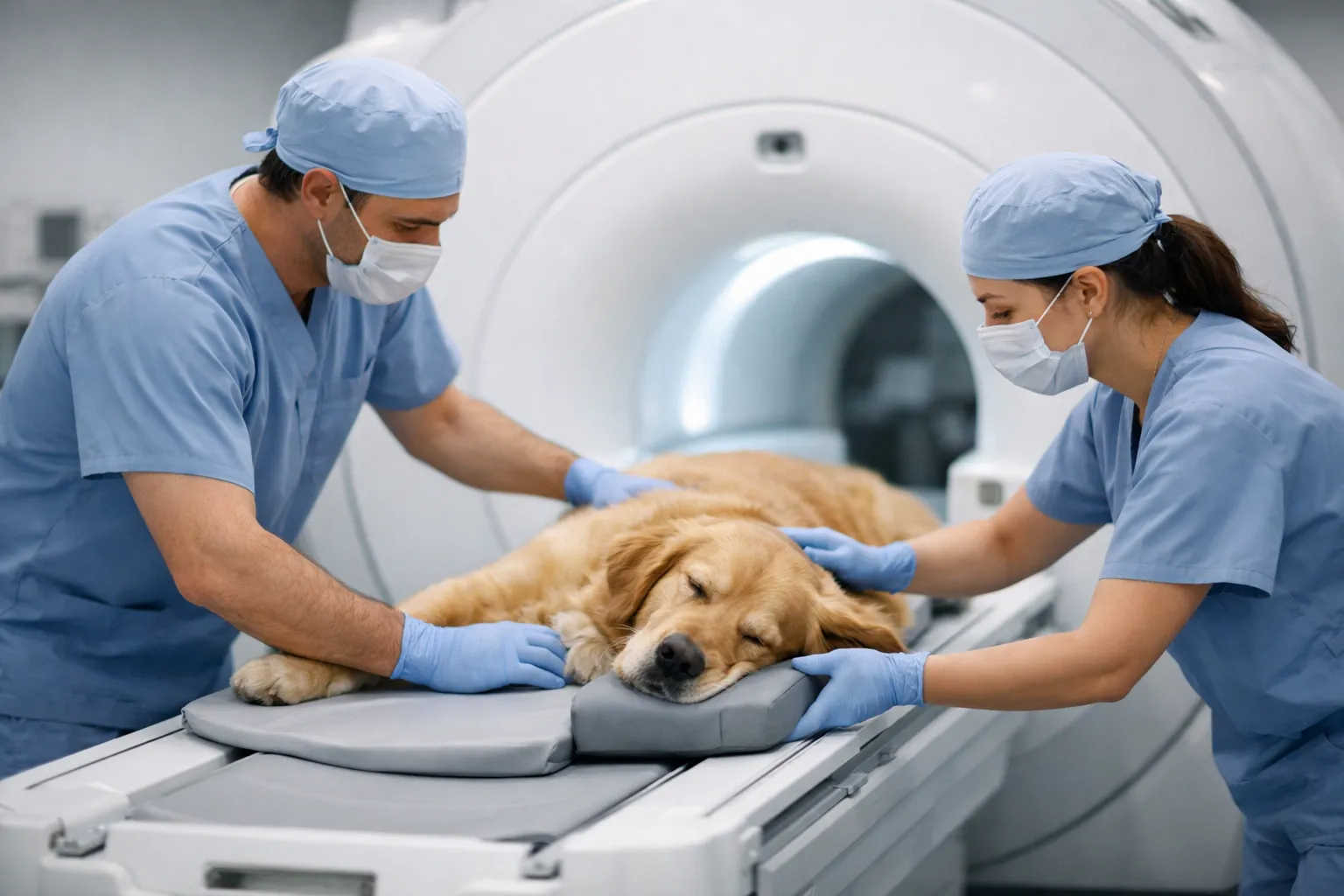
An MRI (magnetic resonance imaging) scan uses powerful magnets and radio waves to create highly detailed images of your pet's brain, spinal cord, joints, and soft tissues. Unlike X-rays, MRI produces cross-sectional images that can reveal conditions invisible on standard imaging. Because your pet must remain completely still inside the scanner, a general anaesthetic is always required.
When is it needed? Your vet or specialist may recommend an MRI if your pet is showing neurological signs such as seizures, head tilting, wobbliness, or sudden paralysis. MRI is also used to investigate spinal disc disease, brain tumours, inner ear problems, and complex joint injuries that cannot be fully assessed with X-rays or ultrasound.
Recovery time: Your pet will need a few hours to recover from the general anaesthetic. Most pets go home the same day or the following morning. The MRI itself causes no pain or side effects. Results are usually discussed within a few days once the specialist has reviewed all the images.